Better Breastfeeding

The first of its kind, an interactive, clinically-proven breastfeeding platform is based on 20 years of patient experience and has been used to treat over 25,000 moms and babies.

Methods
User Research, User Experience, UI Design
Client
Contract
Duration
6 months
Tools
Figma, Figjam

There are few practitioners who are trained in breastfeeding medicine and even fewer who provide safe and effective interventions.

Dr. Dahl is New York’s foremost breastfeeding doctor, infant feeding specialist, and an acclaimed ear, nose, and throat surgeon with over 20 years of clinical practice. She has treated over 25,000 moms and babies with an over 90% success rate and authored two seminal books on breastfeeding.

Dr. Linda Dahl wants to share her learnings and knowledge 24/7 by creating a web app based on her successful practice and seminal books. Give mothers easy access to care...fast.

This web app will create a world where all mothers have access to medically based information and the support necessary to feed and bond with their babies, regardless of their background, location, income level, or breastfeeding goals.

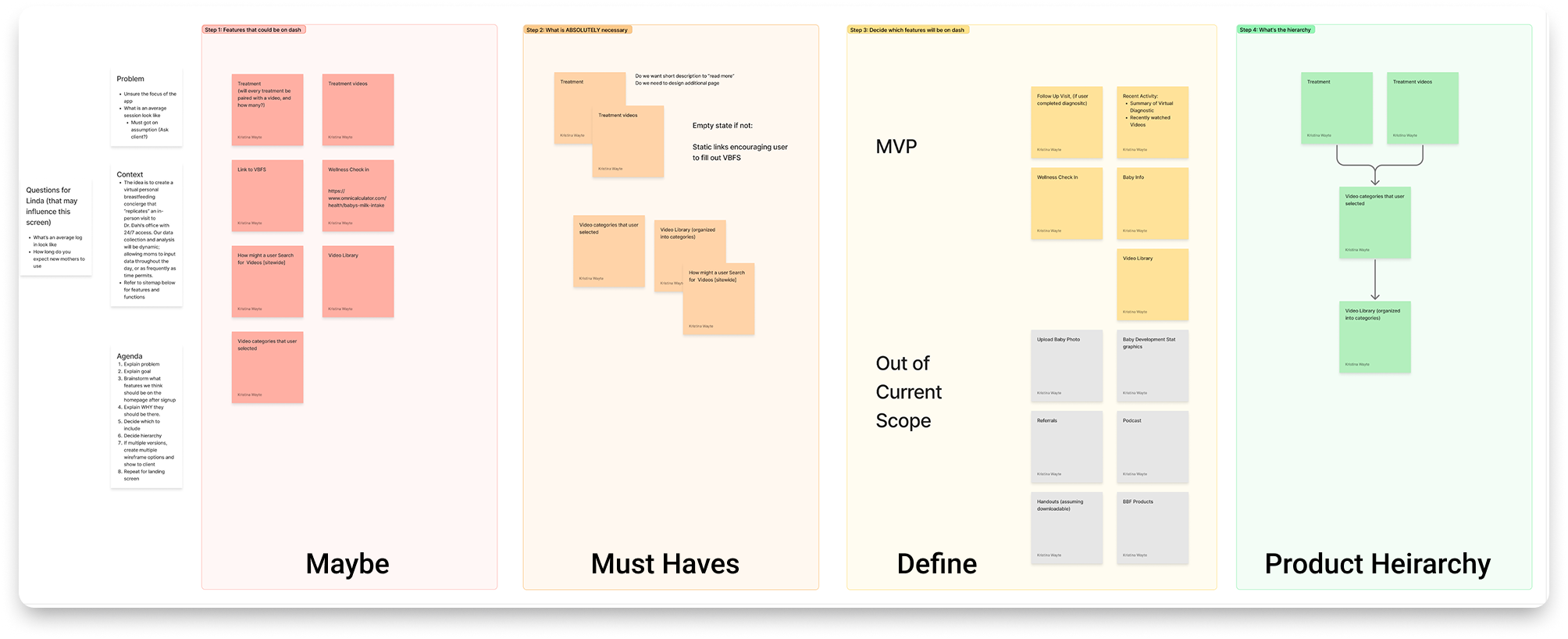
Due to a short timeline, and client availability, we had to be deliberate to deliver within a short deadline. This resulted in leading brainstorming sessions in Figjam to discuss features and define the MVP.

Given six months, the team had to be economical with their time. Dr. Dahl knows her practice well, she knew what the outcome of her product should be, but she did not know where to start. We quickly worked through iterations to define the product. This allowed us to quickly pivot when we discovered that a certain idea didn't fit her vision.

I shared a template in Figjam during a brainstorming meeting to help narrow down an MVP. We discussed all the features that the app could have and put into sticky notes. We would then go through each one and discuss the necessity and value. We also had an engineer in the room to help gauge if a feature had too many unknowns to determine the difficulty. It helped us determine trade-offs and compromises.


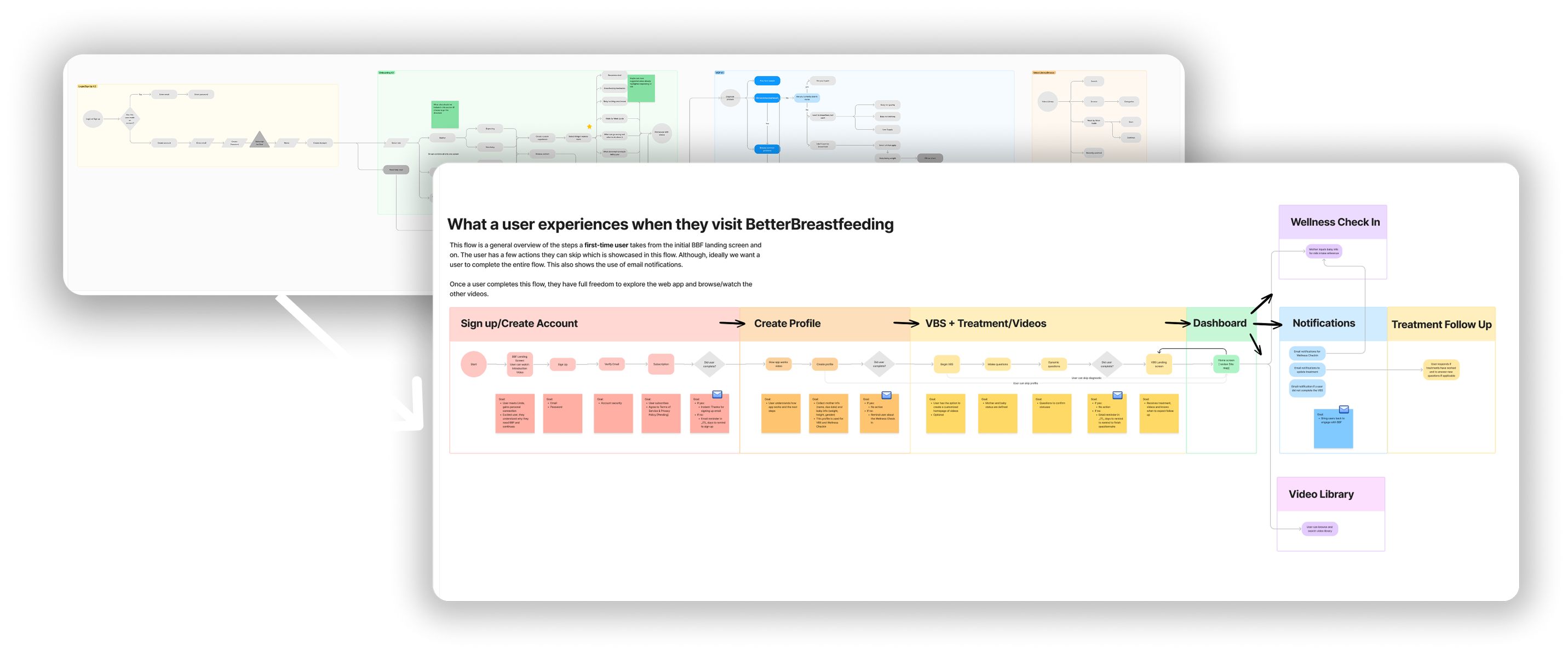
With external clients, it is important to showcase the product experience in simple visuals. I created diagrams and walked the client through the full user experience of the application.

I worked with the product manager and engineer to figure out the flows and functionality. Once that was completed, I simplified our diagrams into a refined presentation for the client.

During this process I helped create the Product Requirement Document that would inform the design team of what to focus on and design. This was also crucial to align our deliverables with the client's expectations. They were so excited about their idea that they kept pitching more features which were out of scope.

Navigated scope expansion while staying in budget.

A simple feature became more complex and the team had to pivot. I had to spend extra time re-iterating what was originally scoped as a simple feature.

Stakeholders became less available while they were working on the video library which meant longer periods of time without showing work. This required us to be more confident in the decision making. We mostly succeeded, but there were some small changes that had to be implemented.

There was no user research budget for this stage, so had to do internal testing. The experience is pretty simple so we felt confident a user can navigate around easily.

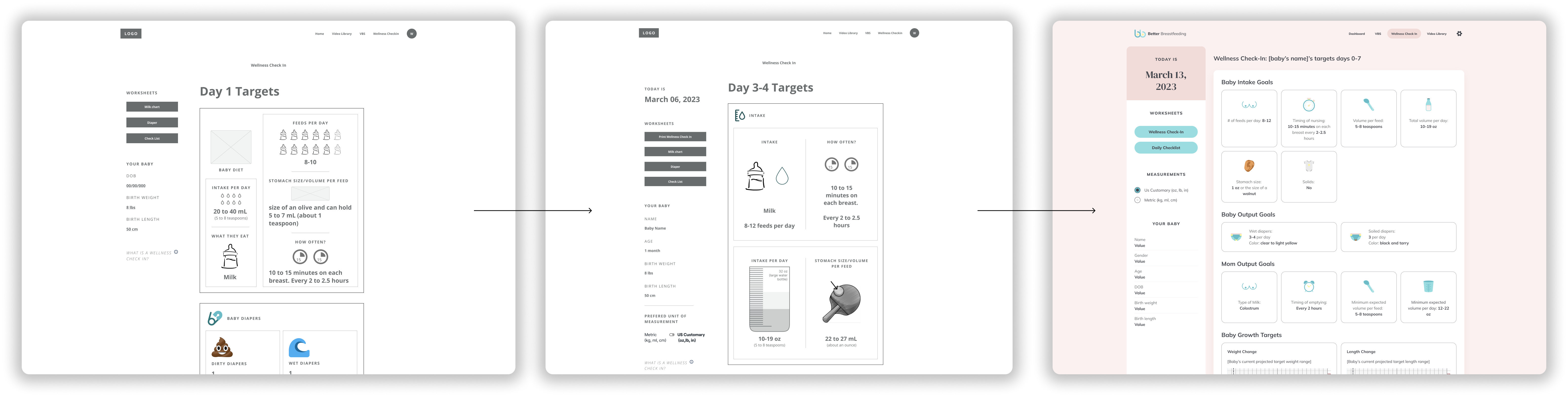
Showed the end-to-end user journey using wireframes to gain feedback from stakeholders quickly. Easy to pivot when not spending precious resources on noodling.

Creating tickets for each feature helped the design team stay organized with who was doing what. The challenge with remote working is staying updated with progress of the project, so tracking each features from flow > wireframe > UI was key.

Final Deliverable: Built a prototype for funding and vision.

Once the wireframes were completed, there was a dev review to make sure that everything could be built or if the dev needed to do some research on functionality. After that review, I handed off the wireframes to the UI designer to update the wireframes with the UI and build a prototype for funding.
Conclusion

Once I was finished with my role, I was on standby for any questions regarding design. The working prototype was delivered on time. The algorithm and functional app were delivered one month after initial proposed deadline. This was organized with stakeholders since the scope increased with the new feature request.